
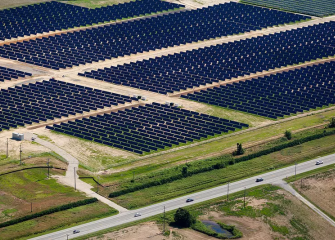
Solar panels on 97 acres in Queeen Anne's County, Md., Photo by chebayprogram with Flickr Creative Commons License
At its Feb. 25 meeting, the Montgomery County Council debated a zoning change to allow a pilot program for the development of solar “farms” in the county’s Agriculture Reserve. A watered-down version of the change passed by a vote of 7-2.
The two naysayers, Councilmember Hans Riemer and Council President Tom Hucker, voted correctly, but for the wrong reasons. As the sponsors of the original measure, they wanted to allow more extensive development than their colleagues approved. Actually, the county should have rejected the program outright and, instead, concentrate on promoting rooftop solar panels.
Stripping away euphemism, solar farms have nothing in common with agriculture; indeed they harm our food chain and the environment as a whole.
What proponents like to call solar “farms” really comprise acres of mirrors on metal pikes, stretching for miles to capture the sun. The mirrors, as we recall from our childhood when we focused a hand mirror skyward, concentrate the rays to produce energy. However, these mirrors blot out the sun on the land underneath. Residents with shady plots of land can see that vegetables and most flowers cannot grow under those conditions. (They even need to buy special grass to plant.)
Massive solar installations would crimp the agriculture in the Agriculture Reserve. Indeed, the prestigious Union of Concerned Scientists came to the same conclusion. In a 2013 report, the group recommended that zoning authorities place these energy projects in degraded land, not useful for agriculture, or in “brownfields” (contaminated soil) and abandoned mines.
Asphalt jungles and abandoned shopping malls might work, but not the Agriculture Reserve.
The problems
Proponents of the project acknowledged the problems. They proposed solutions that, wrapped in gobbledygook, sound good, but do not stand up under scrutiny. For example, Councilmember Riemer suggested switching from “commodity crops” to “agrivoltaics.”
In plain English, he suggests replacing food with the few crops that grow in the dark. According to Wikipedia, quoting a study from Denmark concerning lettuce, even then, “agrivoltaics” require a huge investment. Wikipedia calls these efforts “technologically complex.”
Massive solar installations create another problem as well: “vegetation management.” A Cornell University College of Agriculture and Life Sciences post explains that whatever species of vegetation, such as grass, that grows beneath solar panels needs trimming. I assume that means that high growth can interfere with solar energy production or cause other unsafe conditions. Cornell recommends importing sheep to graze beneath the panels.
Sheep
Riemer mentions “solar grazing” as a means to mitigate economic loss to farmers in the Reserve. Indeed, in World War I sheep kept the White House lawn under control.
However, using sheep in the Agriculture Reserve differs from the White House. Importing sheep costs money. The Cornell post also says that sheep require more secure fences than at typical utility installations, so as not to allow escape. Solar grazing requires protecting the sheep from predators. Also, it requires hiring shepherds.
One might think that the developers will pay for all this. However, the costs will come out in the price of the electricity customers will pay or the county will subsidize with taxpayer money. Besides, given our current knowledge, this will not pan out.
The County Council ignored the expense and other difficulties of building transmission and distribution lines to carry the solar power from the Reserve to the grid. NIMBY (Not in My Backyard) Syndrome will rear its head, not to mention other environmental issues.
Solar power in the proper way
The county should pursue development of solar power, but in the proper way. Unlike windpower, solar does not harm migrating birds or undersea creatures. Solar does not ruin people’s views or make noise. The more logical and cheaper alternative exists in rooftop solar panels.
The county has many roofs in homes and office buildings. Rooftop systems do not require new transmission or distribution lines. Rather, they use existing connections within the buildings. The county can lower costs by allowing owners to reduce their electricity bills by selling excess power back into the grid. Maryland law allows such transactions.
Rooftop solar has drawbacks, but the county can overcome them more cheaply and with less complexity than developing the Reserve. Panels have a short working life. The county should encourage or subsidize improvements. Indeed, over the past two decades, new materials and technology have made panels lighter and more attractive. Education campaigns and creative financing can make rooftop solar more popular and economical.
The county has its heart in the right place. It needs to put its head in the right place as well.

