
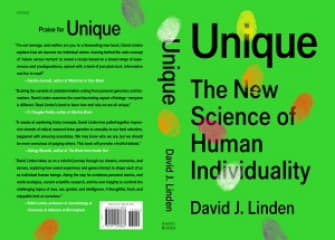
As of this writing, there are – give or take – 7,815,637,687 human beings living on planet Earth. This staggeringly large number is made even more unfathomable by the fact that each one of us is unique in the particular combination of features that make us, well, us.
How we become the individuals we become is the fascinating question that Johns Hopkins Neuroscience professor David J. Linden explores in his latest book “Unique: The New Science of Human Individuality.” It is a big question, and Linden tackles not only the roles that genetics and experience play in shaping who we are, but also the varieties of human experiences found in traits ranging from food and sexual preference to gender and race – and more.
Though covering this vast topic in 256 pages may seem daunting, Linden is an experienced communicator of complex science having previously authored three highly successful books on neuroscience for a general audience (Touch, The Accidental Mind, and The Compass of Pleasure) and edited a book of essays written by fellow neuroscientists (Think Tank). (He also teaches a course at Johns Hopkins University on writing about the brain that I took as a graduate student.)
READ FULL ARTICLE HERE

