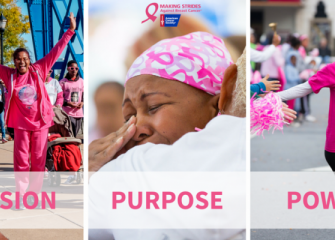
Between 5,000 – 6,000 local breast cancer survivors, caregivers, volunteers, businesses and community members will unite to fight breast cancer at the American Cancer Society’s Making Strides Against Breast Cancer Presented by MileOne Automotive. This noncompetitive, inspirational event raises awareness and funds to fight breast cancer and provides hope to all people facing the disease. www.makingstrideswalk.org/baltimoremd
For the 17th year, MileOne Automotive has donated a new car to raffle to raise funds for the American Cancer Society. The winner of the 2017 Mercedes-Benz CLA250, donated by MileOne Automotive, will be drawn that morning at the event.
WHEN: Sunday, October 16, 2016, Registration: 7.30 a.m., Walk: 9 a.m. rain or shine.
WHERE: The Y at Stadium Place, 900 E. 33rd Street, Baltimore, MD
An estimated 246,660 women in the U.S. will be diagnosed with invasive breast cancer in 2016, and approximately 40,450 will die from the disease. This year in Maryland, approximately 4,880 women will be newly diagnosed with breast cancer and approximately 820 women will lose their lives to the disease. Thanks in part to the work of the American Cancer Society (ACS), the U.S. death rate from breast cancer has declined by 36% since 1989. That means 249,000 lives have been saved.
Since 1993, Making Strides Against Breast Cancer has been the American Cancer Society’s rallying cry to build awareness and generate funds to fight breast cancer. In that time, more than 11 million walkers across the nation have collected over $685 million, helping more than 2.9 million breast cancer survivors celebrate another year. One million participants unite at nearly 300 Making Strides Against Breast Cancer events annually across the nation, raising more than $60 million each year.
Making Strides Against Breast Cancer participants raises important funds for the American Cancer Society to support breast cancer research, offer free patient/caregiver services, provide in-depth cancer information, and support legislative advocacy to make sure all women have access to the care they need.
The American Cancer Society is the largest non-profit funder of cancer research outside the federal government and is leading the way in transforming breast cancer from deadly to treatable and from treatable to preventable. The Society currently has $74 million invested in breast cancer grants and has invested more in breast cancer research than in any other cancer. ACS has played an important part in nearly every major breast cancer breakthrough in recent history, including lifesaving treatments such as Tamoxifen and Herceptin and establishing mammography as the standard for finding breast cancer early.
According to the World Cancer Research Fund International an estimated one third of breast cancers could be prevented through healthy behaviors, including:
- Maintaining a healthy body weight. Losing even a small amount of weight has health benefits and is a good place to start.
- Engaging in regular physical activity. Growing evidence suggests that women who get regular physical activity have a 10%-25% lower risk of breast cancer compared to women who get no exercise. Doing even a little physical activity beyond your regular daily routine can have many health benefits.
- Not drinking alcohol. Many studies have confirmed that drinking alcohol increases the risk of breast cancer in women by about 7% to 10% for each drink per day. For women who drink alcohol, the American Cancer Society recommends they limit themselves to no more than 1 drink per day.
- Eating more fruits and vegetables. There is growing evidence that high levels of fruit and vegetable consumption may reduce the risk of HR-negative breast cancer. These findings are supported by studies linking lower breast cancer risk to higher blood levels of carotenoids
- Breastfeeding. The Collaborative Group on Hormonal Factors in Breast Cancer reviewed 47 studies from 30 countries and concluded that the risk of breast cancer was reduced by 4% for every 12 months of breastfeeding. More recent studies suggest that the protective effect may be stronger for or even limited to triple-negative breast cancers.
- Not smoking. There is some scientific evidence that smoking increases the risk of breast cancer slightly, especially among heavy, long-term smokers and women who begin smoking before their first pregnancy. A recent study by American Cancer Society researchers found that women who begin smoking before they give birth to their first child had a 21% higher risk of breast cancer than did women who never smoked. Quitting has numerous health benefits.
- Getting regular screening mammography. To find breast cancer early, when treatments are more likely to be successful, the Society recommends women should begin having yearly mammograms by age 45, and can change to having mammograms every other year beginning at age 55. Women should have the choice to start screening with yearly mammograms as early as age 40 if they want to.