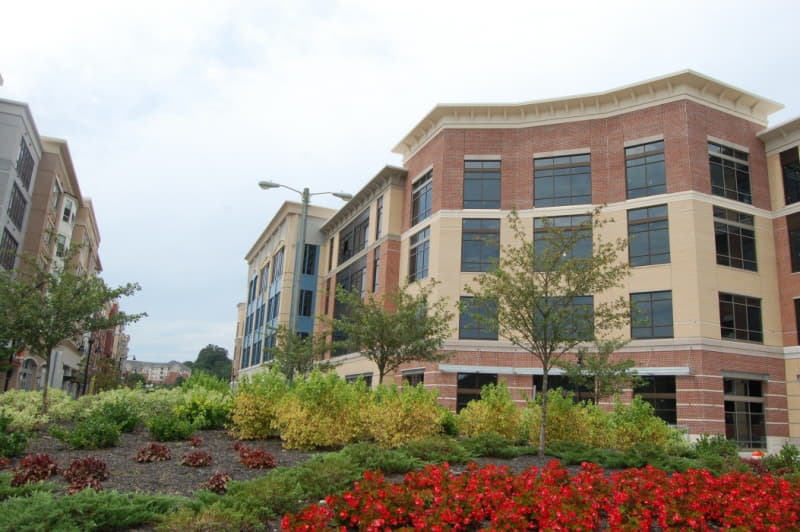
Metro Centre’s New Class “A” Office and Retail Building Fronting on Grand Central Avenue
Creating mini-neighborhoods, finding and implementing creative alliances and using hybrid construction methods is the recipe to energize mixed-use designs, according to an article appearing in Commercial Architecture Magazine and written by Michael C. Johnson, who founded an architectural firm in San Diego. Metro Centre at Owings Mills, a Transit-Oriented Development (TOD) in northwest Baltimore County, is the best example in Baltimore of a project that implements these strategies. Located adjacent to the Owings Mills Metro Station, Metro Centre at Owings Mills is being developed by Owings Mills Transit, LLC and David S. Brown Enterprises, LTD is the site manager.
Mini-neighborhoods: According to the author, the creation of mini-neighborhoods “stimulate a diverse and lively” community. This feature can be found at Metro Centre at Owings Mills in the first phase of the residential component. Phase I consists of two five-story buildings, containing 56,000 square feet of retail space on the ground floor and 240 market-rate apartment homes on the upper four floors. Approximately 1700 residential units will eventually be built at the TOD.
Creative alliances: Johnson writes “our best mixed-use ventures forge valuable coalitions for lasting, positive change” and lists academic institutions as an example. Metro Centre at Owings Mills contains The County Campus Building, a 120,000 square foot project with the largest branch of the Baltimore County Public Library and the Community College of Baltimore County. The Public Plaza of Metro Centre is located adjacent to this building regularly hosts social and entertainment activities and is considered the new gathering place for Baltimore residents.
Hybrid construction: Metro Centre’s new Class “A” office and retail building fronts on Grand Central Avenue and is directly connected to an eight-story parking garage that accommodates 3,000 vehicles and the Owings Mills Metro Station. Key design elements include extra high ceiling heights, open column spacing and expansive floor-to-ceiling windows that stream natural light and provides a modern office environment fostering creativity and vibrancy in the interior spaces with efficiency.
David S. Brown Enterprises, LTD., founded in 1933 and headquartered in