
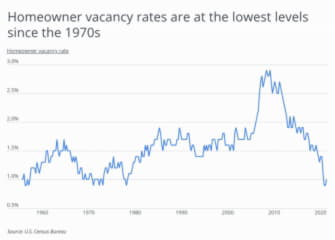
The U.S. is facing a severe housing shortage as the number of homes for sale hits new lows, driving up home prices and making homeownership less affordable. At the same time, buyers are eager to take advantage of record low interest rates. However, finding an affordable home in many parts of the country is incredibly challenging. According to the latest data from the Census Bureau, the homeowner vacancy rate—the share of owner-occupied housing units that are vacant and for sale—is just 1.0%.
Since reaching a record high of 2.9% in 2008 in the midst of the Great Recession, the homeowner vacancy rate in the U.S. has trended downward. After diving to 0.9% last spring in the early stages of the COVID-19 pandemic, the homeowner vacancy rate has inched back upwards. The low rate indicates a housing shortage at the national level, but tracking the homeowner vacancy rate at the metro level can help identify cities with bigger supply-demand imbalances. Changes in homebuyer preferences have resulted in large changes in vacancy rates year-over-year for some metros. The current shift towards working from home—and a shift in preferences away from crowded cities—has spurred demand for homes in smaller cities and towns.
Even before the COVID-19 pandemic hit, the construction industry was struggling to fill a severe housing shortage. The pandemic has only made this more challenging as construction in many parts of the country has faced stoppages, and the price of materials has increased. The number of new housing units authorized, housing starts, and new housing units completed fell drastically during the 2008 housing market collapse. While these numbers have been steadily climbing since 2012, they remain well below the levels seen in 2005. The current supply of new homes has not been able to keep pace with demand.

While the U.S. is grappling with a serious housing shortage nationally, the severity of the housing shortage varies widely by location due to factors such as affordability and local job market conditions. Overall, the Western U.S. has lower homeowner vacancy rates, indicating a lower stock of available homes, compared to the eastern half of the country. Louisiana and North Dakota have the highest homeowner vacancy rates in the U.S., at 2.0% and 1.9%, respectively. At the opposite end of the spectrum, Oregon and Utah, both with homeowner vacancy rates of 0.2%, have the lowest share of vacant homes in the country.

To determine the metros with the highest (and lowest) homeowner vacancy rates, researchers at Porch analyzed data from the U.S. Census Bureau’s Current Population Survey/Housing Vacancy Survey and Building Permits Survey as well as home price data from Realtor.com. The researchers ranked metro areas according to homeowner vacancy rates in the fourth quarter of 2020. In the event of a tie, rates from previous quarters were used. Researchers also calculated the total housing units authorized in 2020, the median home price, and the homeownership rate.
The analysis found that in the Baltimore metropolitan area, 72.8% of households are owner-occupied. In Q4 2020, Baltimore reported a homeowner vacancy rate of 0.7%. Here is a summary of the data for the Baltimore-Columbia-Towson, MD metro area:
- Homeowner vacancy rate Q4 2020: 0.7%
- Total housing units authorized in 2020 (per 10K residents): 29
- Median home price: $324,950
- Homeownership rate: 72.8%
For reference, here are the statistics for the entire United States:
- Homeowner vacancy rate Q4 2020: 1.0%
- Total housing units authorized in 2020 (per 10K residents): 44
- Median home price: $346,162
- Homeownership rate: 65.8%
For more information, a detailed methodology, and complete results, you can find the original report on Porch’s website: https://porch.com/advice/cities-with-the-most-vacant-homes

