
Summary
- McCormick posts a solid FQ3 earnings report led by consumer strength.
- FQ4 guidance was disappointing, but the upbeat fiscal 2021 outlook should give investors plenty to cheer about.
- The balance sheet is clean, and there is room for more M&A to drive growth.
- But much of the positivity is reflected in the valuation at c. 35x earnings, and therefore, I am sidelined.
Overall, it is hard to get more bullish on McCormick (MKC) despite a largely solid earnings result in FQ3. Admittedly, the company has executed well through the pandemic, and could even stand to gain under current conditions as consumers increasingly opt to cook at home. All of this underpins the medium- to longer-term demand outlook, and taken together, MKC is certainly a high-quality franchise. The major hurdle is the valuation, which I believe more than accounts for the upside in its premium c. 35x NTM P/E multiple and keeps me on the sidelines.
Solid Results Led by the Consumer Segment
MKC reported adjusted FQ3 ‘20 EPS of $1.53, slightly above Bloomberg consensus. Driving the beat was strong organic sales growth at +9% Y/Y. Although the adjusted EBIT of $273 million fell shy of consensus estimates, more favorable below-the-line items boosted earnings for the quarter.
Leading the way in FQ3 was Consumer segment growth, but improvement in Flavor Solutions also contributed to the consensus beat. Considering the lower margins in Flavor Solutions, however, the unfavorable mix shift also contributed to some of the EBIT margin miss.
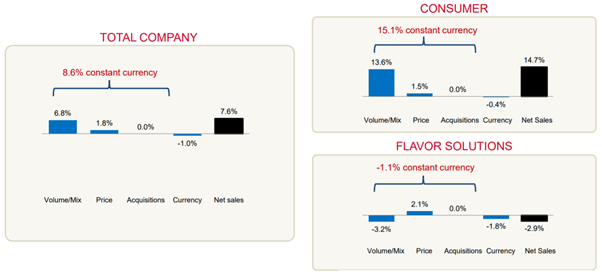
(Source: FQ3 Presentation Slides)
Dissecting Consumer Performance
Headline sales growth in Consumer of 14.7% Y/Y was strong, but the result would have been even higher on a constant currency basis (+15.1% Y/Y). However, the margin performance was relatively disappointing at 22.9%, as a portion of the company’s holiday program was shifted into FQ4. While MKC typically begins to ship holiday-related products in FQ3 to drive “early in-store display and merchandising” of holiday products, the elevated level of demand this time is shifting the focus toward keeping core items on the shelf.
Also notable was management’s decision to invest in additional blending capacity amid a rosier consumer demand outlook. The new capacity (equivalent to an additional manufacturing facility) reflects management’s preference to bring manufacturing in-house over time - the rationale being to optimize production processes and its scheduling system.
But there is a trade-off, and I would note that the move reduces flexibility to scale down capacity should demand slow (a likely outcome if the COVID-19 boost fades). Nonetheless, the company seems confident in the need for incremental capacity to support the fiscal 2021 growth outlook.

