
Summary
- Supernus' earnings trajectory which has been so positive is entering uncharted territory of concern and risk.
- Supernus' management has long been cognizant of, and responsive to, revitalization by acquisition.
- Supernus lined up a deal that offers prospects of covering several key needs.
- Supernus has a potentially bright, albeit very uncertain, future.
Supernus (SUPN) is a company that I have not previously evaluated in any detail. Recently, it has made some moves that have drawn my attention. This article evaluates these developments and their impact on its investment merit.
Supernus' longstanding growth comes under threat.
As a newcomer to Supernus I am unfamiliar with its early history. Judging by the slide from its latest investor's conference below, it has been complicated:

According to the Washington Post, it "IPO'd" in 2012, with an offering of ~10 million shares at ~$5.00; a company press release confirms the same characterization.
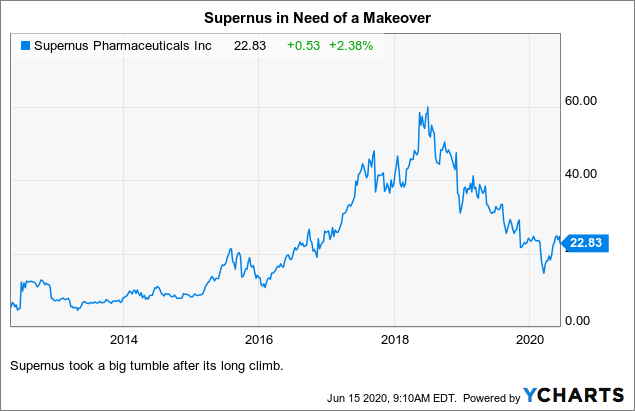
After several years of development following its IPO, its share price path since had been primarily positive-until it peaked at just over $61 in early summer 2018. Since that time it has trended down, hitting a nadir in the low teens in March of this year. The graph below shows its trek from 2012 on:
 Data by YCharts
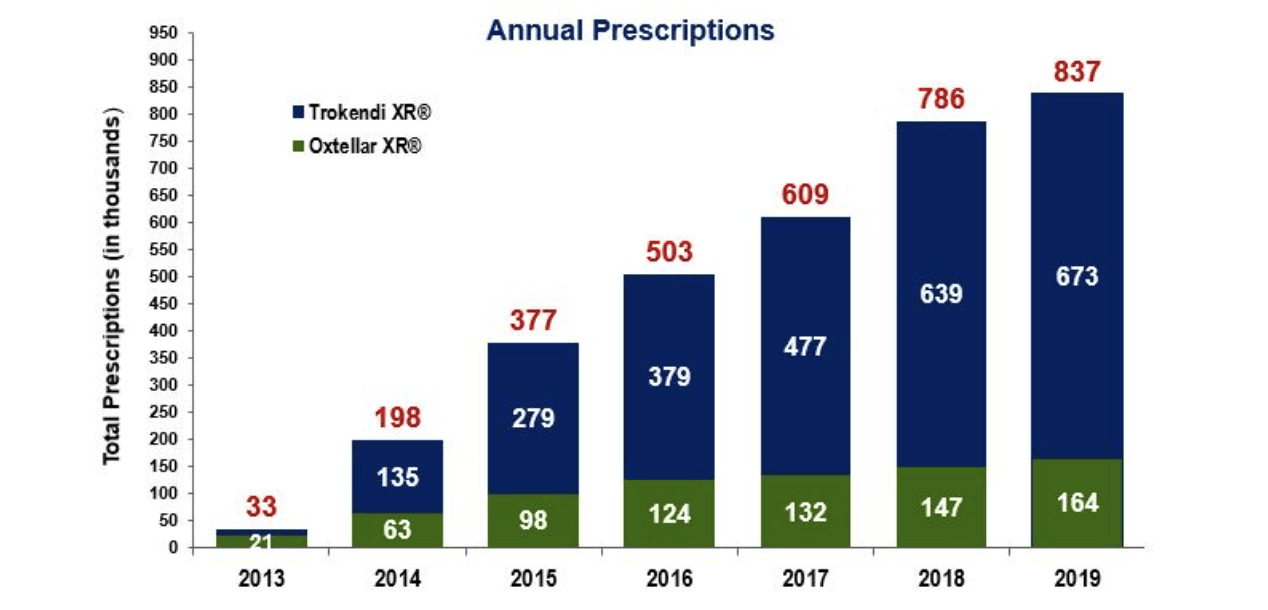
Rising revenues from its two workhorse therapies, Trokendi XR (FDA approved for epilepsy in 2013 and for migraines in 2017) and Oxtellar XR (approved for partial seizures in 2012) fueled Supernus' nice run. Supernus' latest 10-K for fiscal year 2019 (p. 5) describes its situation as follows:
We currently market two products, Oxtellar XR and Trokendi XR in the U.S. Oxtellar XR and Trokendi XR are the first once-daily extended release oxcarbazepine and topiramate products indicated for the treatment of epilepsy in the U.S. market. In April 2017, we launched Trokendi XR for the prophylaxis of migraine headache in adults and adolescents. In January 2019, we launched Oxtellar XR for monotherapy treatment of partial onset epilepsy seizures in adults and in children 6 to 17 years of age. We market our products through our own sales force in the U.S. and seek strategic collaborations with other pharmaceutical companies to commercialize our products outside of the U.S.
Our net product sales of $383.4 million in 2019 were driven by continued growth in prescriptions for Oxtellar XR and Trokendi XR, as shown in the following graph:
 This reassuring upward progression is set for a potential near term disruption compliments of a patent settlement that Supernus executed in 2017 with Zydus Pharmaceuticals and Cadilla Healthcare, collectively "Zydus". Under the agreement, Zydus can begin selling a generic version of Trokendi XR® on January 1, 2023.

