
Summary
- 2U is losing money due to high marketing cost.
- Assuming more normal levels of S&M spend in a steady state, the stock appears undervalued.
- Investors interested in the Edtech space are essentially getting future growth for free, with a company that has an impressive track record and a leadership position in the OPM space.
2U, Inc. (NASDAQ:TWOU) is a $2.3 billion market cap global (however primarily US-based) Edtech company. The company had for a relatively long-time a nice growth story attached to it, where growth has come both from the organic side (driven by heavy S&M spend) and growth through M&A.
As shown below, the stock was on fire during 2017 and half-way through 2018. But questions around ramp-up in profitability put heavy pressure on this equity. The recent upturn is, in my view, linked to increased interest in everything Coronavirus resistant and the fact that the company put up a decent Q1 2020 result.
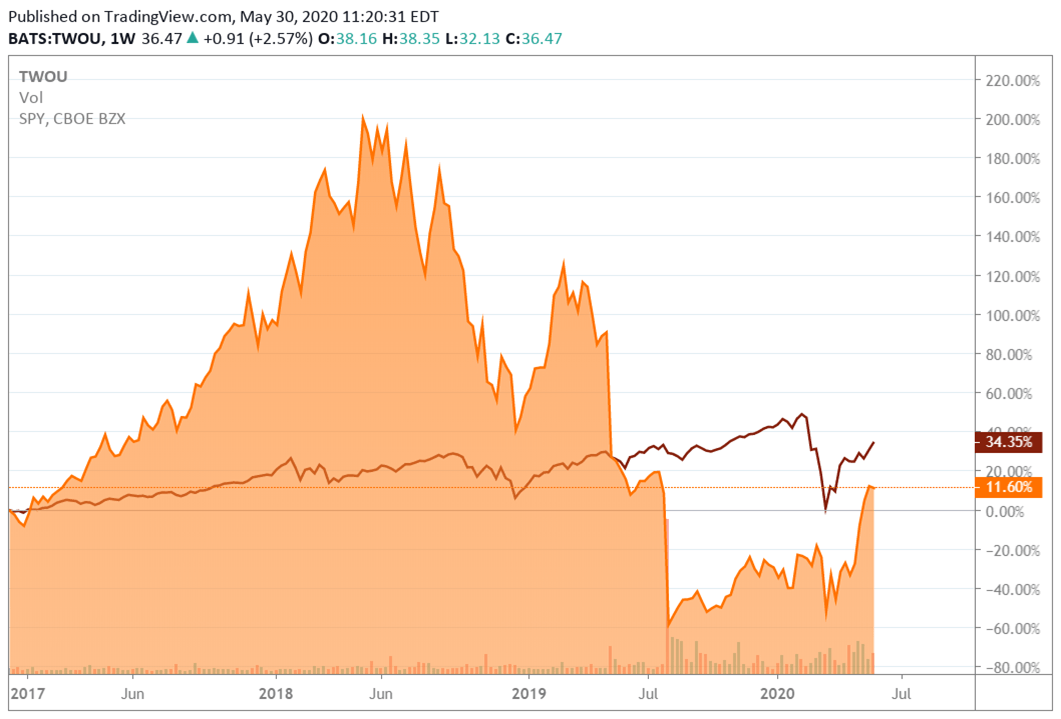
Source: Seeking Alpha
There have been several articles on Seeking Alpha covering from different viewpoints TWOU's merits or faults. In this article, I will briefly present the current bull and bear case and then put forth a more neutral value case (although more on the bullish side) and why the stock is an attractive play if an investor is seeking exposure to the Edtech space.
Bear case
- TWOU provides relatively advanced graduate degree programs, which target white-collars and not necessarily the blue-collar workers hit hardest by the Coronavirus. Hence, when significant parts of the unemployed seek further education, these enrollments will not necessarily push up demand for TWOU programs, i.e. unfavorable product mix.
- The company was an early entrant into the space of online college education (the company started providing educational services in partnership with USC during 2009) and when colleges and universities develop their own offerings from scratch they will not need TWOU to act as a middleman. Furthermore, the universities will have a better bargaining position and demand a larger share of the total price paid by the consumer (student).
- During 2019 the company made a large acquisition. Due to this, the company took on debt. The net cash position of $471 million (debt + leases - cash) as at 31 December 2018, became a net debt item of $143 million as at 31 December 2019. The equivalent figure was $180 million as of 31 March 2020 and since the company's EBITDA is negative (LTM figure was $(104) million), the company may face a liquidity issue.
- Although top-line growth has been impressive (Q1 2019 was 44%), the organic growth was "only" 15% (excluding the impact on sales growth from the acquisition of Trilogy).

