
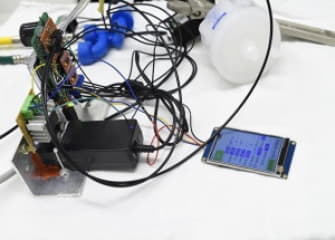
A team of Johns Hopkins engineers has developed a prototype for a pumpless ventilator that can run for 24 hours on a single 12-volt battery. Designed to operate on pressurized air and oxygen lines already available in hospitals or from simple pressurized air and gas sources in the field, the device has fewer moving parts than traditional ventilators and can be manufactured quickly and relatively inexpensively—factors especially crucial during the current COVID-19 pandemic.
The team is now testing its prototype in the Johns Hopkins Medicine Simulation Center.
"We went with a pumpless design because of its simplicity—fewer moving parts," says Nick Keim, deputy director of the Johns Hopkins School of Engineering's Energetics Research Group and leader of the team developing the prototype. "By not having a pump, we push that part of the problem outside of the ventilator itself, and the design and manufacturing for the parts that are specific to the patient get simpler. These ventilators can share infrastructure that already exists in hospitals. Even outside of hospitals, it will be relatively easy to distribute pressurized oxygen from a liquid oxygen truck to patients."
READ FULL ARTICLE HERE

