
Summary
- Exxon's stock has not risen much in 10 years. On Sept. 18, 2009, the stock closed at $69.99. That means it has risen 3% over 10 years.
- Exxon would have benefited from a more focused buyback program. My model shows that if it had bought back more shares, EPS and dividend per share would have skyrocketed.
- My model shows that Exxon's dividend per share 10 years later would be 50% higher if it had spent more money on buybacks.
- The stock price would be significantly higher as well as a result of the higher EPS value.
- This article shows how that model works. Subscribers to the Total Yield Value Guide have access to the spreadsheet.
- This idea was discussed in more depth with members of my private investing community, Total Yield Value Guide. Get started today »
Exxon Mobil's Stock Price Performance Has Been Paltry

Exxon Mobil (XOM) has had virtually no growth in its stock price in 10 years. On Sept. 18, 2009, the stock closed at $69.99. That means it has risen a total of 3% in 10 years. The company has been profitable but decided to spend money on dividends rather than buybacks. This article proposes that more of the money should have been spent on buybacks. As a result, the dividend would now be 71% higher and the stock price would be as well. I will describe how this model works and show the results. Subscribers to the Total Yield Value Guide can view and download the spreadsheet.
Shares Outstanding Have Not Declined Much
As of June 30, there were 4,231 million shares outstanding. Five years ago, at the end of June 2014, there were 4,265 million shares out. That is a drop of less than 1%. In fact, at the end of 2014, the shares outstanding were higher. You can see the slowdown in XOM's buyback activity over the last 10 years below, which shows the year-end shares outstanding:
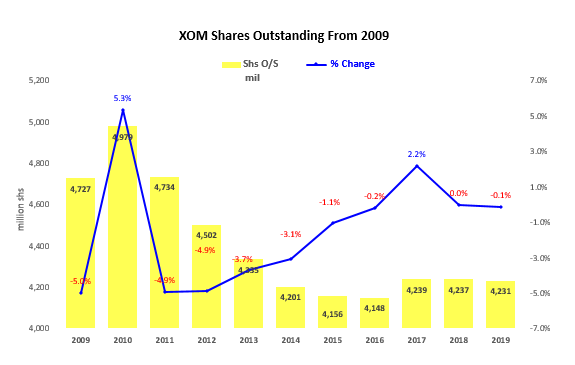
Source: Hake compilation using Seeking Alpha data
The table below shows that over the last 20 years XOM used to have a higher buyback program which reduced its shares. But in the last 6 years, it has significantly slowed down its repurchases.

