
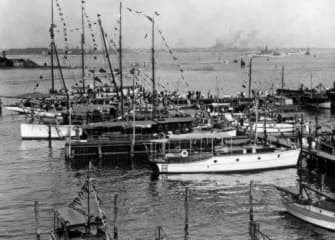
Photograph by A. Aubrey Bodine • © Copyright Jennifer B. Bodine • Courtesy of www.aaubreybodine.com
View from Maryland Yacht Club (1927) - Start of the International Race. From Current MYC website: In the spring of 1909, the Club raised $8,000 and built a clubhouse on piles on the northern shore of the middle branch of the Patapsco River between the present Hanover Street Bridge and Ferry Bar. A picture of this clubhouse is in our current clubhouse. When more than a few sail boaters joined the club, it was decided to change the name to Maryland Yacht Club, which was done on December 17, 1919. Soon after that, the Western Maryland Railroad bought Ferry Bar from the city, forcing the Club to a new location. The sunken yacht Violet was raised and towed to where the Hanover Bridge Marina is today, and it became the clubs new home. The membership at that time was 138. A picture of the Violet is also in our clubhouse. Commodore Rosenblush’s Seylla, in the picture, won a silver cup on August 22, 1914, and this is the Club’s oldest trophy. By 1925 the membership had outgrown the Violet so they moved to Broening Park, which was owned by the city and is now the location of Harbor Hospital. Twenty thousand people were present to see the opening ceremonies and the first power boat race in Baltimore. Commodore Fredrick led a Fleet Review of 65 boats that day. The basin grew to 188 slips and was a model for other clubs throughout the country. The membership in 1929 was 665.
This image may be ordered by typing in the 5 digit image ID # 40-696 in the box below Bodine's portrait on the Home Page.
 A. Aubrey Bodine (1906-1970)
In photographic circles around the world, A. Aubrey Bodine was regarded as one of the finest pictorialists of the twentieth century. His pictures were exhibited in hundreds of prestigious shows, in scores of museums, and he won awards against top competition.
Aubrey Bodine's photographic career began in 1923 covering stories with his camera for the Baltimore Sunday Sun. He travelled throughout Maryland and created remarkable documentary pictures of a multitude of occupations and activities. Moreover, these documentary pictures are of the very finest quality, often artistic in design and lighting effects far beyond the usual standard of newspaper work.
Bodine submitted photographs to national and international salon competitions and consistently won top honors. Bodine believed that photography could be a creative discipline, and he studied the principles of art at the Maryland Institute College of Art. The camera and the dark room equipment were tools to him like the painter's brush or the sculptor's chisel.
Not the least of Bodine's artistic ability was his craftsmanship. He was always experimenting with his tools. Some of his best pictures were literally composed in the viewfinder of the camera. In other cases he worked on the negative with dyes and intensifiers, pencil marking, and even scraping to produce the effect he had in mind. He added clouds photographically, and made other even more elaborate manipulations. Bodine's rationale for all these technical alterations of the natural scene was simply that, like the painter, he worked from the model and selected those features which suited his sense of mood, proportion and design. The picture was the thing, not the manner of arriving at it. He did not take a picture, he made a picture.
For more information about this remarkable man, the full text of the biography of A. Aubrey Bodine, A Legend In His Time, written shortly after his death by Harold A. Williams, Bodine's editor and closest friend, can be found on the website at www.aaubreybodine.com.
More than 6,000 photographs spanning Bodine's 47-year career are available for viewing on the website www.aaubreybodine.com. These images can be ordered as reprints and note cards at www.aaubreybodine.com.
For additional information please write to: info@AAubreyBodine.com or call 1-800-556-7226.

