
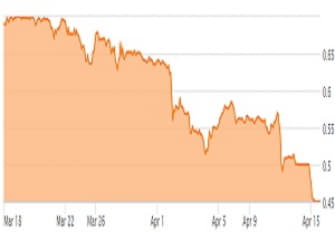
As Rite Aid's (RAD) shares have plunged over the past two-plus years, the problem has remained rather consistent: over that stretch, RAD's stock simply has never been that cheap. It's become cheaper than it was, certainly, but never on its face a value play for two reasons. First, profits and cash flow have steadily declined: Adjusted EBITDA fell 22% on a pro forma basis in FY18 (ending March 3), rose less than 1% in fiscal 2019, and is guided to drop again in FY20. Free cash flow, based on guidance, is likely to be roughly breakeven, or maybe slightly positive, in this coming year after a significant (if largely working capital-driven) burn in fiscal 2019.
Secondly, the most obvious peers - Walgreens (WBA) and CVS (CVS) - have seen their own multiples shrink. Both larger drugstore rivals trade at five-year lows. Rite Aid's heavy debt load means similar multiple reductions have an outsized impact on its equity value; indeed, since the beginning of 2018, its enterprise value loss is almost exactly equivalent to that of Walgreens:
READ FULL ARTICLE HERE

