
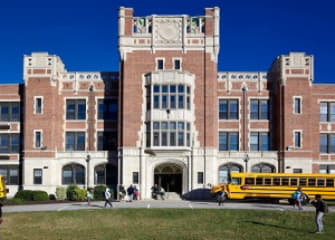
Green Street Academy (http://www.
The certification was achieved in May 2016, and today, Oct. 12 at 4:oo p.m., a representative from the USGBC will present a plaque to the school’s executive director Dan Schochor and its architecture firm Hord Coplan Macht. Invited guests of the ceremony include the project’s developers Seawall Development Co., its construction company Southway Builders / MCN Build JV, and financiers Bank of America, the Abell Foundation, and The Reinvestment Fund, as well as local elected officials and members of the media. Tours of the facility will follow plaque presentation.
“Green Street Academy receiving the highest possible designation for sustainable construction in the renovation of a Baltimore landmark is yet another example of the school putting its mission of creating a more sustainable, future-focused way of educating students into action,” remarked Dan Schochor, Green Street Academy’s executive director. “Much has been made about the importance of creating 21st century-prepared students through education, and there is no better way to accomplish that goal than to surround those same students with a structure that very literally supports that mission and vision.”
Under the LEED Schools v3 Rating System, the 111,000-sq.-ft.-facility achieved certification for implementing practical and measurable strategies and solutions aimed at achieving high performance in: sustainable site development, water savings, energy efficiency, materials selection and indoor environmental quality. Sustainability and resiliency strategies were integrated into the green building process and project, including:
Site
Connections to community and neighborhoods
Shares building and site with Kingdom Life Church
Allows school to grow in future with master plan
Supports public transportation, bikes, and pedestrians
Reduces total amount of parking and shares with church
Preferred parking for fuel efficient vehicles and carpools
Maximizes open space and outdoor learning areas
Reduces “heat island effect” with reflective roofs
Water
Uses water efficient landscaping
30 percent modeled water use reduction
Reduces kitchen process water use
Energy
38 percent modeled energy reduction
Enhanced commissioning system verification
7.5 percent on-site renewable energy with photovoltaic parking canopies
Materials
Reuses 100 percent of existing building’s walls, floors, roofs
Reuses 66 percent of existing interior non-structural elements
84 percent of construction waste diverted from landfills
41 percent recycled materials installed
20 percent regional materials installed
Indoor Environment
Indoor air quality during construction and occupancy
Provides acoustical performance for all learning areas
Installs low emitting (no-to-low VOC) materials
Group and individual control - thermal comfort and lighting
Provides daylight and views to exterior
Further sustainable strategies were developed into an overall Master Plan including:
The Landscape of Demonstration
Habitat Conservation Meadows
Water Resource Exhibit (with Cistern Fed Gardens)
Entrance Canopy with Green Roof
The Landscape of Production
Community Fruit Orchard
Hoop Houses, Raised Garden Beds, Chicken Coops, and Tilapia Fish Farms
Renewable Energy Array (PV parking canopies, sunflower fields and renewable energy research zone)
The Landscape of Learning
Global Outdoor Classroom (with Bio-retention and Wetland Habitat)
Flexible Recreation Fields / Space
The Landscape of Experimentation
Interactive Aquaponics Center (enclosed courtyard with media beds, raft beds, aquaculture tanks, and vertical gardens)
Forestry Laboratory
“Buildings are a prime example of how human systems integrate with natural systems,” said Rick Fedrizzi, CEO and founding chair, USGBC. “The Green Street Academy project efficiently uses our natural resources and makes an immediate, positive impact on our planet, which will tremendously benefit future generations to come.”
In addition to its LEED Platinum Certification designation, Green Street Academy has received several accolades since the renovated school was opened in 2015, including:
Public Building of the Year, AIA MD, 2016
Wintergreen Presidents Award, USGBC -MD, 2016
Excellence in Construction Award, ABC Baltimore, 2016
Project of the Year, ABC Baltimore, 2016
Rehabilitation Award, Baltimore Heritage, 2016
About LEED
As the most widely recognized and widely used green building program across the globe, LEED is transforming buildings, homes
About Green Street Academy:
Green Street Academy (GSA) is an innovative public middle-high charter school, inspiring scholars with sustainability and preparing them for college and career through project-based learning. Originally constructed in 1925, the former Gwynns Falls Park High School (125 N. Hilton Street) sat nearly vacant for more than 20 years in an urban site in Southwest Baltimore. An overhaul that was completed Sept. 2015, transforming what’s now Green Street Academy into a community anchor and a state-of-the-art, sustainable building shaping a generation of citizens prepared to create a greener and more sustainable world. In May 2016, the school achieved a LEED Platinum certification under the Schools v3 rating system, making it the first and only in Baltimore and the state of Maryland, and the second largest in the world, as of the date of certification. Learn more at www.greenstreetacademy.org.
About Hord Coplan Macht:
Founded in 1977,Hord Coplan Machtis a national leader in sustainable design with over 200 employees in three offices in Baltimore, MD, Denver, CO and Alexandria, VA. Hord Coplan Macht has a diverse studio environment designing award-winning projects in education, multifamily/mixed use, senior living, healthcare, landscape architecture, historic preservation and planning to serve the needs of our clients.


