
Summary
- The hospitality sector is unlikely to recover in the next 24-36 months and will almost assuredly underperform vis a vis other market sectors.
- Whole segments of the hospitality sector as it existed prior to COVID-19 will likely never return.
- Within the sector, however, Marriott will likely retain its place as the market leader, but with a substantially smaller revenue base.
- Marriott has always been adaptive and creative. Revenues lost by a big change in the hospitality sector will be recovered in other sectors.
New York (July 22nd) - We've been unabashed cheerleaders of the Marriott (MAR) team since we first initiated coverage and suggested a “Buy” at around $65 in February, 2016. But in the face of COVID-19 in the USA, its spread, and the challenges it has presented for all companies in the travel sector, it’s time for a reassessment.
Some Background
When Marriott reported its Q4 2019 earnings in February, we had suggested that investors buy on the dip, reasoning that the fall in the share price because of COVID-19 concerns in China would make a prime buying opportunity because of the relatively small percentage of profits earned by the company from Asia. Like others, we were relying on the expertise of Dr. Fauci and others who suggested the COVID-19 virus was not an imminent threat to the US or our economy. Events subsequent to that article in late February obviously proved those expectations to be wrong. The virus subsumed the US travel industry and had a catastrophic effect on the US economy. There are two things investors should consider when evaluating Marriott in the post-COVID-19 long term: (1) Will revenues return to their prior levels; and (2) Can Marriott survive a shortfall if they do not?
Will Revenues Come Back?
On June 1st, CEO Arne Sorenson said that Marriott hotels in Asia had reopened and were over the 40% occupancy threshold. That’s not great, but it is certainly an improvement over the occupancy rate during the height of the crisis.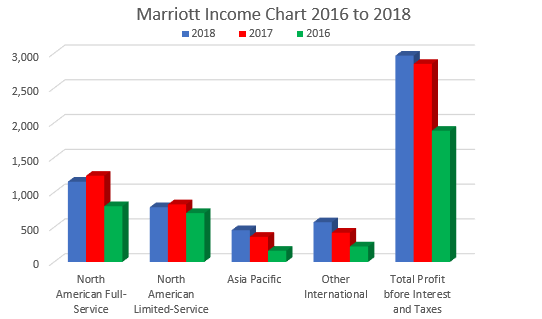
Source: Stuyvesant Square Consultancy from Marriott SEC filings. (USD billions)
But as you can see from the chart, the majority of Marriott fee revenues comes from North America, where COVID-19 is still wreaking havoc, to a greater or lesser degree, throughout the United States, Mexico, and Canada. We wrote back in April that the other side of COVID-19 was likely to be worse than was then being anticipated. Recent job recoveries have made us only slightly more optimistic, and we believe much of the “hires” were likely businesses who brought back staff to qualify for federal loan forgiveness. At best, we think there will be a “U-shaped” recovery, and more likely we will have an “L-shaped” recovery; that is, a deep recession (or depression) that will continue into at least the third quarter of 2022. Keep in mind, too, that we are only six months into the COVID-19 pandemic. The H1N1 global flu pandemic ran from April 2009 to September 2010 before being declared ended. The 1918 Spanish Flu Pandemic lasted 26 months.

