
Summary
- One of the top-performing property sectors in 2020, Industrial REITs have proven to be relatively immune from the coronavirus-induced pain that has encumbered much of the commercial real estate sector.
- Fueled by the "Stay-at-Home" economy, the coronavirus pandemic has significantly accelerated the adoption and penetration rate of e-commerce. Online sales nearly doubled while many brick-and-mortar locations were shuttered.
- Performance has been driven by the "need for speed" in consumer goods delivery as retailers continue to invest heavily in supply chain densification, driving relentless demand for industrial space.
- Industrial REITs didn’t skip a beat during the outset of the pandemic. Same-store NOI growth topped 5% in Q1 while leasing spreads topped 20% as the supply/demand outlook remains favorable.
- While the pandemic poses a continued threat to this economically-sensitive sector, early signs of a consumer-led economic rebound have quelled our near-term concerns about a damaging slowdown in consumer spending.
- This idea was discussed in more depth with members of my private investing community, iREIT on Alpha. Get started today »
REIT Rankings: Industrial
(Hoya Capital Real Estate, Co-Produced with Brad Thomas)
Industrial REIT Sector Overview
One of the top-performing property sectors in 2020, Industrial REITs have been relatively immune from coronavirus-induced pain that has encumbered much of the commercial real estate sector. In the Hoya Capital Industrial REIT Index, we track the 14 largest industrial REITs, which account for roughly $100 billion in market value. Riding the e-commerce wave, Industrial REITs have delivered seemingly relentless outperformance over the past half-decade, powered by the "need for speed" in consumer goods distribution, and comprise between 10% and 15% of the broad-based Core Equity REIT ETFs.

Fueled by the "Stay-at-Home" economy, the coronavirus pandemic has significantly accelerated the adoption and penetration rate of e-commerce, which has positive long-term implications for industrial real estate demand. Nearly half of retail sales were completed through e-commerce channels since the beginning of the pandemic and the critical importance of having sophisticated and seamless e-commerce operations has become even more self-evident to retailers and consumers alike. The e-commerce penetration has jumped to nearly 25% in May 2020 from less than 15% at year-end 2019.
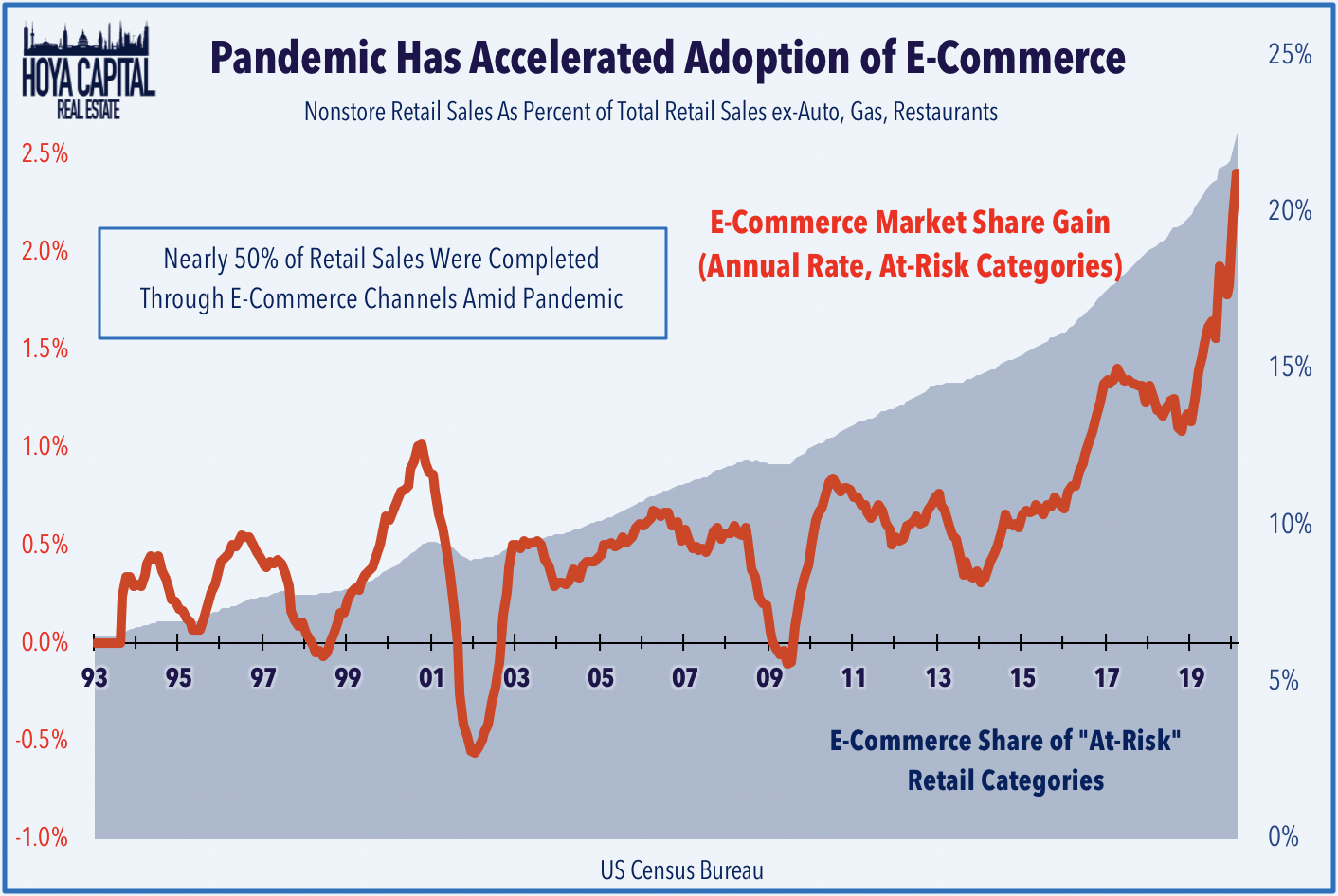
Importantly, e-commerce is far less efficient than traditional brick and mortar from an industrial space usage perspective as brick and mortar shelf space is effectively "replaced" by back-end logistics space. Each dollar spent on e-commerce requires roughly three times more logistics space than the equivalent brick and mortar dollar, according to estimates from Prologis (NYSE:PLD), and retailers have invested heavily in supply chain densification. It's not just Amazon (AMZN) that is making heavy investments in its e-commerce business. The traditional brick-and-mortar powerhouses have honed the omni-channel approach with significant success, as Walmart (WMT), Home Depot (HD), Target (TGT), and Costco (COST) have been among the biggest investors in e-commerce distribution over the last several years, the fruits of which were clearly on display during the pandemic-related shutdowns.

