
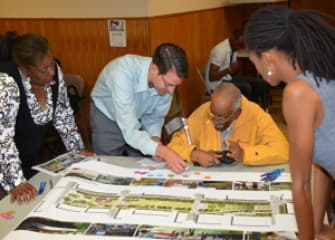
Joe Burkhardt, Project Manager (second from the left)
Community-driven design celebrates a proud history and welcomes a vibrant future
Eager Park, a five and a half acre park at the core of an unprecedented $1.8 billion dollar development in East Baltimore, marks its official opening with a ceremonial ribbon-cutting on May 6th at 1:00 PM. Forest City | New East Baltimore Partnership tasked Mahan Rykiel Associates, Inc. (MRA) to lead the design of a dynamic park to serve the recreational and programmatic needs of local residents, nearby workers, students, and visitors. The park celebrates the history of the community and its proud residents while serving as an anchor for economic development.
MRA President Richard Jones reflected, “In a day and age of limited resources and dwindling budgets, continued cultural and racial divide, it is critical that when we have an opportunity to build projects, we do so with the intent to also build and strengthen communities. If we want the places we build to last, they must be rooted in meaning and be authentic to the people who we build for, whether long time community residents or those we are hoping to attract. It is our hope that Eager Park will be the centerpiece of such a place. A common ground where people of varying backgrounds… residents and workers, old and new can come together to not only celebrate the past, but together, create a better and brighter future.”
MRA teamed with Gensler Architects to drive the park’s human-centered design strategy deploying extensive community engagement and visioning sessions to draw in and stimulate dialogue about the future of the park. The team’s process yielded a layered set of design principles based on community values, civic responsibility, cultural awareness, local history, social impact, neighborhood ownership and active play. Various user groups gave voice to the plan including long-time neighborhood residents, teens and students, school teachers and staff, Hopkins medical staff, graduate students, new residents and young families, as well as long-term Hopkins patients.
“We hosted a series of public town halls, advisory committee meetings and follow-up workshop sessions to engage the community in the design for the park,” says Design Strategist Elaine Asal. “The project team and stakeholders recognized how critical community input would be to making sure we were reflecting residents’ needs.”
A PROUD HISTORY
Cultural identity was of prime importance to many of the long-time residents and local community from whom the design team drew inspiration.
Throughout the park, various placards can be found honoring community heroes such as Clarence H. "Du" Burns, the first African-American Mayor of Baltimore City, and Calvin Tyler, the first African-American UPS driver hired in Baltimore who eventually became UPS Vice President of Operations. The terraces set into the slopes of the southern block of the park carry inspirational quotes and statements rooted in the fabric of the community. Most prominent and maybe most important in conveying the overall mission of the park is the statement ‘WE ARE EAST BALTIMORE’ which stretches along the face of the lower terrace. They are words that informed almost every aspect of the design.
Jones elaborates, “The community wanted something lasting, something that both reflected their long and proud history, as well as captured their hopes for a brighter future. That desire informed not only the structure of the park, but also the elements within it. From the intertwined paths of the fitness loop, derived from the human DNA helix, a nod to Henrietta Lacks and her contributions to Hopkins medicine, to the use of simple yet honest materials like wood, steel and concrete that symbolize stability, strength and honesty, to the open lawns and elevated perch of the overlook… the park embodies the spirit of the people of east Baltimore, both old and new.”
BRINGING PEOPLE TOGETHER
Eager Park provides multiple spaces for people to come together and interact, including the southern plaza, amphitheater, overlook, pavilion, great lawn, playground and community garden.
An interactive fountain in the plaza along Ashland Avenue invites children and adults to play in its playful grid of jets; the water rising into the air and splashing audibly on the plaza surface. The expanse of textured paving provides ample opportunity for both programmed and impromptu events, whether annual festivals or occasional food truck gatherings, the plaza is designed to be a hub of urban, neighborhood centered activity.
On the west side of the plaza, a grove of trees leads visitors to the overlook, an elevated platform that provides expansive views, stretching three city blocks for the length of the park. Past the amphitheater’stiered, north facing lawns, the T. Rowe Price Pavilion comes into view as a focal point for community gatherings. The pavilion, designed by Gensler Architects, serves as a venue for performances while also providing fully accessible flexible space for the community.
Gensler Principal, Peter Stubb comments, “The pavilion provides an iconic gathering space and also serves as an inspiring symbol of community, of bringing people together. We are honored to have worked with the larger project team and East Baltimore community on the design for this self-sustaining park.”
INTEGRATED WELLNESS – RECONNECT AND RECHARGE
One of the primary goals of the park is integrated fitness, health and wellness. Beyond the pavilion are intertwining paths with exercise hubs, a community garden, reading nooks, open-field play areas, and a future playground site to be installed by the community in conjunction with national non-profit Kaboom!. The variety of paths provide multiple routes for walking and running, as well as passive uses, to take advantage of the environment’s many benefits.
Various materials and designated spaces throughout the park uniquely address health and wellbeing for people and the environment. Fiber soils in the lawn areas allow athletic field use and durability as well as quick, efficient drainage. Root paths tap into the lawn area from trees lining the park for increased water and oxygen, helping not only the vitality of the trees but also mitigating bulging roots along pathways. Toward the western edge of the park, richly planted bio-swales collect rainwater. The native plant palette offers a lush variety of color throughout the seasons. Educational placards explain how bio-swales function and their role in protecting the environment. A Kebony boardwalk, a sustainable alternative to tropical hardwoods, offers a passive walkway around the swales and serves as a refuge for people to reconnect with nature and recharge. The boardwalk’s wood brings warm tones to the material palette, while the decking serves as a permeable surface.
Project Manager Joe Burkhardt of MRA explains, “Instead of following cookie cutter approaches to stormwater management, we’ve strived to make the technology serve the end user as well as the environment. We found that what’s good for the park ends up being good for people too.”
Located on the west side of the park, the boardwalk connects with an active-use path system that widens gradually, providing ample room for shared pedestrian and bicycle use, as well as clearance for emergency vehicles. Following the edge of the park is a half-mile loop with various features for a full-body workout. The amphitheater steps allow for bodyweight workout routines like dips and incline push-ups. The middle of the park provides a quarter mile loop without crossing traffic for a more traditional track experience. There are two exercise hubs located along this pathway with equipment for various exercises.
Burkhardt continues, “For many in the community, gym costs are prohibitive… having the exercise equipment provides an amenity many have never had an option of making part of their daily life.”
The tree lined walk along Wolfe Street is the formal spine of the park. It is both path and place, allowing for casual strolls or active jogging, while also accommodating opportunities to simply sit on one of the many benches to enjoy the sights and sounds of the park. The high limbed branches of this shaded stretch also allow for clear sight lines into the park, an important element in the overall safety and sustainability of city parks.
Scott Levitan, Sr. Vice President of Forest City - New East Baltimore Partnership (FC NEBP), comments, “Eager Park is opening the sky up to a beautiful community and the types of activity that will make us stronger. The community’s involvement has been instrumental in making this park a reality.”
The organizations, individuals and businesses that made Eager Park possible are recognized with commemorative tree medallions throughout the park.
Selected through a public process initiated by the city and state, Forest City – New East Baltimore Partnership (FC NEBP) is a group of national and local real estate developers. Working in partnership with EBDI, Johns Hopkins, The City of Baltimore, the State of Maryland and Baltimore’s philanthropic foundations, FC NEBP is taking the vision of the community and laying the foundation for residents to live, work, and learn.
Mahan Rykiel Associates is a full service landscape architecture firm located in Baltimore Maryland with a staff of 45, serving clients on five continents. Mahan Rykiel’s mission is to make places more sustainable, equitable and ecological through creative collaboration and design. Visit our website at www.mahanrykiel.com.

