
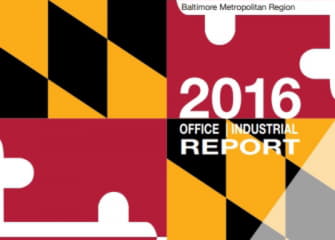
NAI KLNB has released its 2016 Office and Industrial Market Report covering vacancy rates and absorption levels in Baltimore City, as well as Anne Arundel, Baltimore, Cecil, Frederick, Harford, Howard, Montgomery and Prince George’s Counties. The sixteen-page report also reveals five trends predicted to shape the commercial real estate marketplace in the Baltimore-Washington, D.C. region in 2017. Last year, NAI KLNB reported volume of more than $1.4 billion on 1,011 separate real estate transactions.
The five identified real estate trends are:
Local economic and real estate impact of national political agenda
Slight grins formed around the mouths of commercial real estate professionals with knowledge that a businessman that made his fortune by developing real estate was about to assume the presidency of the United States. Is that optimism well founded?
The past two years of Democratic rule were marked by uncertainty about the direction of the economy and the cost of new regulations, which stunted and deterred the expansion of small and medium-sized businesses (coupled with the general belief that a Hillary Clinton presidency would only heap on more costs). While preparing for this scenario which seemed like a certainty all summer and fall, both large and small businesses reeled in or minimized their investment in people and space in the quest for efficiency.
With the Baltimore-Washington, D.C. market inextricably tied to the federal government and defense spending, the general consensus is that a Republican-controlled Congress translates to tremendous news locally. The reduction of corporate taxes and softening of real estate regulations will also spur activity. Talk of eliminating or altering the 1031 rule for tax-free exchanges is seemingly off the table with this administration.
Maryland momentum continues
Under Governor Larry Hogan’s “breath of fresh air” administration (entering year three) that supports and values businesses, as well as instills confidence in the corporate community, the State continues to distance itself from its “business unfriendly” reputation earned from the previous eight years. Institutional money continues to target the region, given its proximity to our Nation’s Capital and the fourth largest consumer market in the country, as well as an educated labor market, a diverse business economy including the medical and high-technology sectors and transportation amenities that are difficult to replicate elsewhere in the country.
Of course, when it comes to growing the economy, it is all about growing the jobs. Nothing happens without that – end of story. And in Maryland, this is a success story. The State unemployment rate hovers around 4 percent, compared to the national rate of nearly 5 percent. Approximately 35,000 new jobs were added in the State last year.
Will limited supply of investment-grade product continue?
There was a significant drop-off in the sale of investment-grade commercial office buildings, warehouse and industrial product and retail centers, both locally and nationally. Office buildings located in non-urban areas, some of which are leasing-challenged or distressed, represent one product type that is bucking the trend and deals can be had with some trading in the $40 to $60 per square foot range. The number of warehouse buildings sold in the Baltimore region dropped from more than 76 last year, to less than 32 this year.
Lower interests remain one of the key culprits, as they inspire the demand to acquire what is available which, in turn, creates a small pool of properties to choose from. With demand remaining high, now may be the time for owners to consider marketing their assets, as rumors persist of an interest rate hike that could throw cold water on the current sales environment.
Market factors dictate continuing re-purposing trend
Warehouse buildings are being converted into residential housing. Old factories and warehouses are being repurposed into “funky” mixed-use developments. Product is being demolished everywhere to make way for the best and highest new use. This trend is expected to continue if not gain strength given the high barriers to entry that exist in urban areas for new real estate developments, coupled with high regulatory approval needed for ground-up construction. Functionally-obsolete industrial and office product will continue to be targeted for redevelopment into collaborative workplaces.
All eyes on Maryland with mega-projects
Three separate development projects, arguably the largest and most ambitious in the country - and containing diverse product types - are shining spotlights on our region. National Harbor, the $4 billion project overlooking Washington, D.C. and the Potomac River, recently added the $1.3 billion MGM casino to its collection of restaurants, retailers and the Gaylord National Resort and Convention Center. Port Covington won approval from the City of Baltimore for $660 million of bonds to jumpstart the Under Armour-backed $5.5 billion mixed-use development that is expected to generate more than 35,000 jobs and provide housing for about 12,000 people. And TradePoint Atlantic, recognized as the largest industrial project on the East Coast, is expected to inject 17,000 new jobs into its 3100 acres,
End-of-year vacancy rates among Class “A” office buildings by market were:
Anne Arundel County - 12.5%
Baltimore City - 14%
Baltimore County - 10.8%
Harford County - 41.8%
Howard County - 6.1 %
Frederick County - 11.1%
Montgomery County -16%
Prince George’s County - 26.4%
Investment overview: Historically low interest rates fueled a very busy and robust real estate capital markets industry in 2016. Within the permanent loan market, life insurance companies and commercial banks dominated, while the commercial mortgage-backed securities (CMBS) sector fell off a bit. 2016 was lower than any other year going back decades with the ten-year Treasury rate bottoming out at 1.37% in June. The insurance companies and banks were regularly writing fairly aggressive ten-year loans in the neighborhood of 3.5%.
For 2017, it is anticipated that the permanent commercial mortgage markets will continue to be strong with lots of liquidity, but with large uncertainty surrounding the future direction of rates. The Mid-Atlantic commercial real estate markets should continue to rank as one of the most favored areas by lenders for its relative stability, growth potential, and the economic engine of the federal government and its associated contractors.
For a free copy of the market report, contact tpowell@klnb.com
NAI KLNB is a full-service brokerage firm with Maryland offices in Towson and Columbia, as well as Vienna and Dulles, Virginia. KLNB is the Mid-Atlantic representative of NAI, a network of real estate service providers serving 55 countries, 375 local offices and 6,700 local market leaders.
Paragon Commercial Property Management, a subsidiary of KLNB, LLC., is a full-service provider of commercial real estate property and asset management services.
For additional information, visit www.klnb.com

