
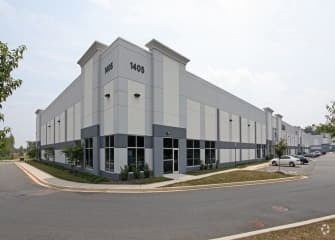
1405 Tangier Road, Baltimore Crossroads@95
This article was recently published in Southeast Real Estate Business magazine.
Bigger – and strategically located – continues to be better in the Baltimore metropolitan region when it comes to the industrial real estate product sector. Blink your eye these days in Charm City, and you might miss the latest 100,000 to 500,000 square foot transaction that transpired, fueled by the seemingly insatiable appetite among retailers to warehouse consumer products near large population areas and maintain same-day or next-day delivery models. Companies involved with the production and distribution of food products and home goods are the next most prolific users of warehouse and industrial space.
The avalanche of large-scale logistics-related leases first started in 2014 when Amazon.com leased a one million square foot fulfillment center with Duke Realty in Baltimore City. Recent notable activity includes RPM Warehouse (435,000 square feet at Baltimore Crossroads in White Marsh);Pier 1 Imports (644,000 square feet in Harford County) IKEA (300,000 square feet with Federal Capital Partners in Halethorpe); Canusa Corp Fiber Group (320,000 square feet in Dundalk); Sephora Americas (320,000 square feet of renewal space in Harford County, plus an additional 620,000 feet of new space);FedEx Ground (300,000 square feet at TradePoint Atlantic); US Lumber (260,000 square feet with MCB Real Estate and One Liberty Properties); Capital Seafood (160,000 square feet at the Baltimore-Washington Logistics Center); and American Tire Distributors (144,000 square feet at Baltimore Crossroads). And, that is just a sampling.
The Baltimore-Washington, D.C. region is considered the fourth largest in the country with more than ten million people and a Combined Statistical Area approaching $700 million. The white-hot condition of the market runs parallel to the momentum nationally of the industrial sector. According to an article appearing in The Wall Street Journal, rental rates for this product sector rose 9.9% in 2015 and new construction starts remain behind demand in new markets. Companies, in an effort to achieve the fastest speed of delivery, have realized that they need to warehouse products within close proximity to major population centers. Baltimore can reach approximately one-third of the US population within a one-day truck drive.
Significant projects of note in Baltimore include: TradePoint Atlantic, a 3100 acre industrial site that is being developed on the site of the former Bethlehem Steel plant in Sparrows Point, by a joint venture of Redwood Capital Investments and Hilco Real Estate. It has already attracted Harley Davidson and FedEx Ground.Port 95 Industrial Park, a project of Chesapeake Real Estate Group represents a redevelopment of the former Sun Products Corporation in Baltimore City and will include more than one million square feet of new or retrofitted space. MRP Industrial’s Eastgate Logistics Center in Harford County will contain nearly 2.3 million square feet of industrial space in Harford County when completed. The Baltimore-Washington Logistics Center, a project of Manekin, LLC, is designed to offer more than one million square feet of institutional-quality and has already attracted a major food tenant. More than one million square feet of industrial space is contained within Baltimore Crossroads in Baltimore County. And, for something completely different, FRP Development Corporation delivered this year a new 80,000 square foot speculative warehouse building at Hollander Business Park for smaller users of space, ranging from 5000 to 30,000 square feet.
Generally, a good news – bad news – good news scenario exists within the marketplace. Starting with the positive side, the amount of capital needed to fund new industrial developments andleases exceeds the pipeline of available deals. The investment world recognizes the strength of this market and the industrial sector as a whole and is anxious to put skin in the game. On the negative side, the general consensus is that all land sites suitable for industrial and warehouse development is accounted for in the Baltimore region. Which isn’t all bad news, as this situation has stimulated brownfields development or the demolition or retrofit of previously-abandoned sites including the former Bethlehem Steel and Sun Products plants in downtown. A “flight to Pennsylvania” situation exists, with industrial developers seeking raw land opportunities, particularly in the Leigh Valley area (approximately two and one-half hours from Baltimore).
National consumer and real estate trends, combined with local fundamentals suggest that we can expect more of the same in the foreseeable future. Research indicates that the e-commerce industry will maintain its growth rate of 15 to 20% annually, with retailers continuing to make the transition from three-to-two day delivery models to same-day delivery.Any product related to food, clothing and home improvement will lead the charge.
Baltimore remains popular given its large population center, the availability of a highly-skilled labor market, proximity to a major port and airport and a mature highway network. Developers are seizing this opportunity with a rash of new projects underway throughout the City and neighboring counties. In reality, the forecast cannot be any more promising.

Matt Laraway is Partner of Chesapeake Real Estate Group, LLC, headquartered in Baltimore, Maryland, a full-service commercial real estate operating company that includes brokerage, property management and development services. He can be reached at mlaraway@cregllc.com

